


Why Being a Good Trail Layer Matters in Mantrailing
- Aug 17
- 5 min read
When you think about Mantrailing, it's easy to focus on the dog and handler team. But there's another person playing a crucial role behind the scenes...The Trail Layer.
The Trail Layer is the person responsible for laying the trail and hiding at the end for the dog to find, but their role involves far more than simply disappearing and waiting to be found.
Their role has a direct impact on the training experience. In fact, a good Trail Layer can make a huge difference to a Mantrailing dog's learning and development.
A Trail Layer's job isn't just hiding, they're a vital part of the training team.

What Does a Trail Layer Do?
The Trail Layer has several important jobs during a Mantrailing session.
They need to:
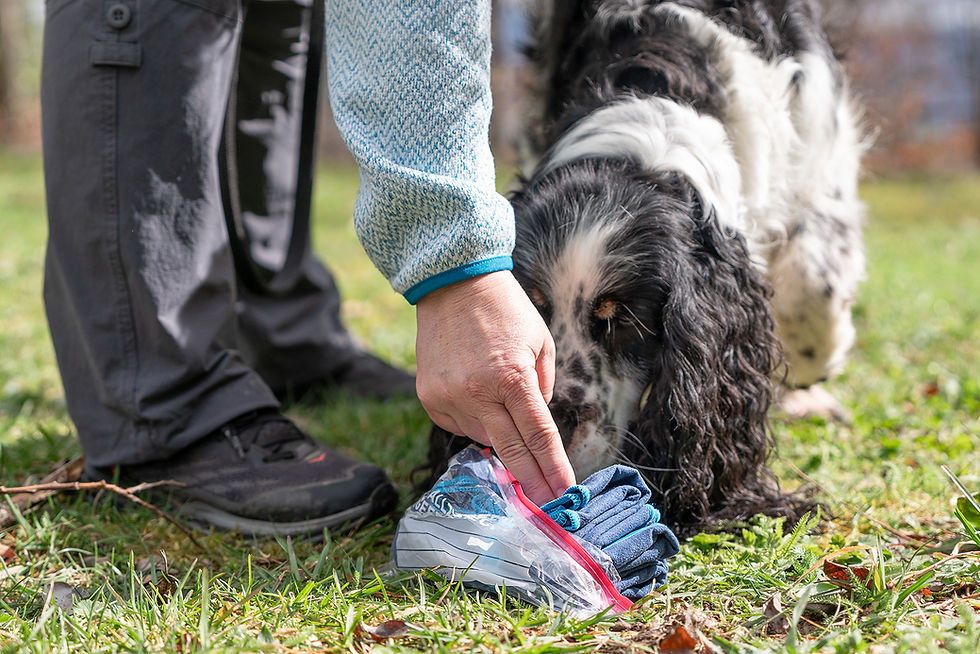
Create and store the correct scent article.
Follow the instructions given by the instructor.
Fire the dog up appropriately when instructed.
Lay the trail exactly as instructed.
Hide appropriately for the dog and the exercise.
Reward and party with the dog in the way they've been instructed.
Every part of this process matters because the Trail Layer is helping to create the correct training set up and learning experience for the dog.
Creating and Storing the Scent Article
Before a dog can follow a trail, they first need to be able to take scent from the scent article. That makes the scent article one of the most important parts of the Trail Layer's role.
The scent article should be an appropriate item containing ONLY the Trail Layer's scent, and it needs to be handled and stored correctly to avoid unnecessary contamination.
Why does this matter?
Imagine you pick up a sock from a family wash basket. It's been mixed in with everyone else's clothes, so it's likely to carry the scent of multiple people. If you then present that sock to the dog when those family members aren't present, you're potentially giving the dog information about more than one person.
So how would we know who the dog is actually being asked to search for?
The dog doesn't know which scent we intended to present. They're simply processing the scent information available to them.
That's why careful scent article preparation and storage is so important. We want to give the dog the clearest possible information about who they're searching for.
Firing Up the Dog Correctly
The Trail Layer can also play an important role in firing the dog up before the trail begins.
But firing a dog up isn't simply about getting them as excited as possible. The aim is to create the right level of motivation and focus so the dog is ready and willing to work.
Too little motivation and the dog may not be engaged enough to want to find the Trail Layer. Too much excitement, however, can scare some dogs, or push them over threshold and make it harder for them to think and make good decisions.
That's why you may be asked to fire a dog up in a very specific way. The approach should always be based on the individual dog and the instructions from your instructor.
Follow Instructions for setting up the trail
One of the most important things you can do as a Trail Layer is listen carefully to the instructions and follow them exactly.
Every trail is designed around the individual dog and handler team, so what might be an appropriate challenge for one team could be completely unsuitable for another.
This is important during Known or Single Blind trails, where the handler, instructor or both are relying on the Trail Layer to lay the trail exactly as instructed in order to step in and support the dog on the trail if needed.
It can be tempting as a Trail Layer to add an extra challenge, change the route, take an unexpected turn or 'test' the dog, but doing so can completely change the exercise.
The handler may believe their dog is working a particular trail, while the instructor is assessing their behaviour against the planned route. If the Trail Layer deviates from those instructions, the training exercise can be compromised, making it much harder to accurately assess the dog's performance and potentially impacting their learning and progress.
Your job isn't to decide what makes the best trail. Your job is to create the trail you've been asked to create.
Hiding correctly
When you reach the end of your trail, you might think your job is simple:
Find somewhere to hide and wait...But where and how you hide and wait is a really important part of the exercise.
Your instructor may ask you to hide in a particular position, make yourself less obvious, remain completely out of sight or become part of a more challenging scenario. The aim is always to create an appropriate challenge for the individual dog and handler team.
This becomes particularly important when working with nervous, sensitive or reactive dogs. For these dogs, how you present yourself at the end of the trail can make the difference between a positive, successful encounter and a big mistake.
You may be asked to remain still, avoid eye contact, position yourself in a particular way or wait for specific instructions before interacting with the dog. Getting this wrong could create an unnecessary negative experience for the dog and potentially set their training back.
And if you move too soon, show the rewards, call the dog, make eye contact or give them clues before they're supposed to find you, you're potentially influencing the outcome.
Your job is to create the experience the instructor has designed for that individual dog.
Throwing the right party
And then there's everyone's favourite part... The find!
When the dog reaches you, your job as the Trail Layer is to reward them exactly as instructed. This might involve food, toys, play, praise or a combination of rewards, depending on the individual dog and the exercise.
One of the most important rules to remember is: Don't touch the dog unless you've been specifically instructed to as part of the party.
For some dogs, being touched by a stranger at the end of a trail could be overwhelming, uncomfortable or even frightening. The find needs to be a positive experience, and that means respecting the individual dog's boundaries and allowing the handler or instructor to guide the interaction.
The way you party with the dog matters too. For some dogs, a huge enthusiastic celebration is exactly what they need. For others, too much excitement can push them over threshold or create a negative experience at the find.
Your instructor and handler will give you specific instructions about how to reward and interact with the dog because the reward is part of the training.
The aim is to create a positive association with finding the Trail Layer and reinforce the behaviour the dog has just performed.

A Great Trail Layer = Great Training
The next time you're asked to be a Trail Layer, remember just how important your role is!
You're not simply walking out and waiting at the end of a trail for a dog to come and find you. You're another vital piece of the puzzle that helps create the learning opportunity for a dog and handler team.
Prepare and store the scent article carefully, listen to instructions, fire the dog up appropriately, lay the trail as instructed, hide appropriately and throw a party that's right for the individual dog you're working with.
Every part of your role matters, probably more than you realised.
Love learning about Mantrailing? Join our Online Mantrailing Club for in-depth training, video lessons and on-going support
👉 Learn more here: https://www.mantrailingglobal.com/mantrailing-membership
Want to turn your passion for Mantrailing into a career?
Our Mantrailing Global Instructor Course gives you the knowledge, practical skills and confidence to teach Mantrailing to others.
👉 Discover more here: https://www.mantrailingglobal.com/instructorcourse


I came across 192.168.16 while exploring networking basics. Clear information about local addressing can help users understand how router settings work and why accurate network information matters when managing Wi-Fi, connected devices, and everyday configuration tasks.
Thank you for this insightful post! I completely agree that being a good trail layer is vital. It reminds me of the online games io the thrill of pushing boundaries while ensuring safety and teamwork in mantrailing. It's all about balance!